Review · TOURS
Sarajevo: Grand Walking Tour Through Time and Cultures
Sarajevo’s story is easiest to grasp on foot, and this tour gives you a clear route through the city’s many layers. You move from the Latin Bridge, linked to the assassination that helped trigger World War I, through Ottoman market streets, Austro-Hungarian buildings, religious landmarks, and the scars and renewal of modern Sarajevo.
I like two things especially: the route connects famous sights with ordinary streets where craftspeople still work, and the guides explain difficult subjects with warmth rather than turning the tour into a dry lecture. The possible drawback is simple: three hours on foot is a lot, and the activity information says it is not suitable for people with mobility impairments, despite also listing wheelchair accessibility. Ask for specific route details before booking if that matters to you.
Key points at a glance
- The Latin Bridge puts World War I in a real Sarajevo street setting, not just in a textbook.
- Baščaršija and Kazandžiluk show Sarajevo’s Ottoman-era marketplace culture, including traditional copper work.
- City Hall and the House of Spite explain the city’s Austro-Hungarian architectural turn with memorable local stories.
- Mosques, churches, a synagogue museum, and the Meeting of Cultures reveal Sarajevo’s long religious and cultural mix.
- Guides such as Kenan, Elma, Bojan, Tarek, and Masha are praised for clear storytelling, humor, patience, and useful local advice.
- At $21 for three hours, the tour offers strong value if you want orientation and context before exploring alone.
Why this three-hour route works so well
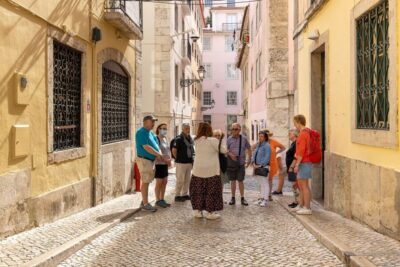
Sarajevo can feel confusing at first because its architectural eras change within a few blocks. A minaret, a Catholic cathedral, an Austro-Hungarian facade, a Serbian Orthodox church, and a market selling baklava may all appear within the same walk.
That is the central strength of this experience. You are not simply ticking off sights. You are learning how Sarajevo became a meeting point between Eastern and Western traditions, and how Ottoman, Austro-Hungarian, Yugoslav, and modern influences still appear in daily life.
The route is also useful for a first day in town. You finish with a mental map of central Sarajevo and a list of places to revisit at your own pace. Several guides also give food suggestions and practical tips, which can help you choose where to eat and what to see after the tour.
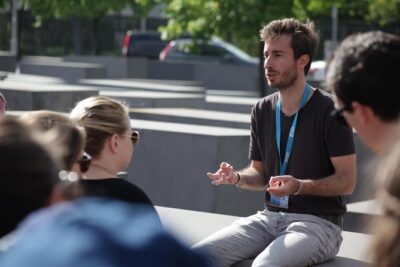
The tone appears to vary slightly by guide, but the strongest pattern is clear: guides explain complex events plainly, welcome questions, and add personal or local stories. Kenan is praised for balancing documented history with anecdotes and humor. Elma is noted for clear English and thoughtful answers. Bojan brings warmth and hope when discussing the city’s more painful recent past.
More Walking Tours in the world:
- Magical London: Harry Potter Guided Walking Tour
★ 4.7 · 22,044 reviews - Reykjavik Food Walk – Local Foodie Adventure in Iceland
★ 5.0 · 18,952 reviews - History and Hauntings of Salem Guided Walking Tour
★ 5.0 · 14,564 reviews
Starting at the Latin Bridge and Emperor’s Mosque
The Latin Bridge is an effective opening because it links Sarajevo to a major turning point in European history. Near this spot, Archduke Franz Ferdinand and his wife Sophie were assassinated in 1914. Your guide explains the event and its wider consequences, including how a local act in Sarajevo helped set off World War I.
The value here is the setting. You are standing beside the Miljacka River, looking at the actual urban space connected to the event, rather than hearing about it in a museum room. If World War I is your main reason for visiting Sarajevo, this stop gives you the essential starting point.
The route then continues toward the Emperor’s Mosque. This introduces Sarajevo’s Ottoman period and the city’s Islamic architectural tradition. You should expect a guided explanation and photo stop rather than a long interior visit, so dress comfortably and respectfully.
These first stops establish the tour’s method: one site, one period, then a connection to the next. That approach helps you keep Sarajevo’s long timeline in order.
From monastery and brewery to Sarajevo City Hall
The next section moves through a monastery and the Sarajevo Brewery, each used to add another layer to the city’s story. The monastery stop is brief, listed at about five minutes, while the brewery also serves mainly as a photo and explanation point.
The brewery is especially useful for understanding that Sarajevo’s past is not only Ottoman. The city’s food, drink, businesses, and architecture also reflect later Central European influence. You may not spend long at either stop, but they break up the larger historical story with recognizable local places.
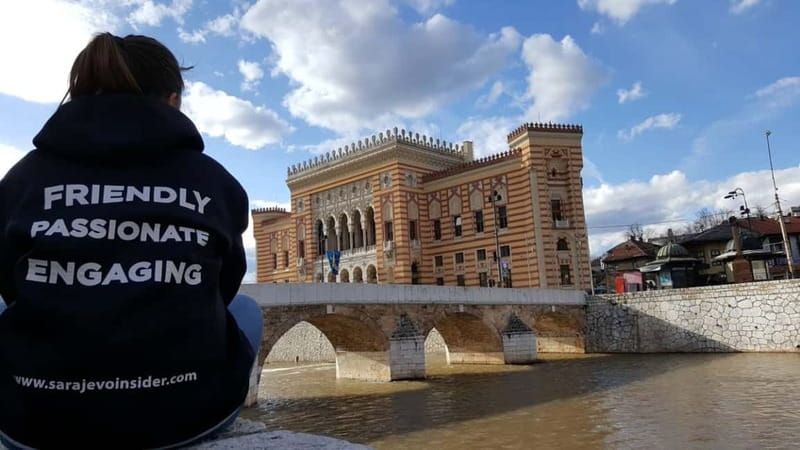
Then comes Sarajevo City Hall, one of the city’s most memorable buildings. Its neo-Moorish design reflects the Austro-Hungarian period, when officials reshaped parts of Sarajevo with grand civic architecture. The building gives you a useful contrast with the older Ottoman streets you have already seen.
This is one of the tour’s best visual transitions. In a short distance, Sarajevo shifts from intimate lanes and religious courtyards to a large public building with an ornate, highly formal style. The guide’s explanation matters here because the building is more than a photogenic facade. It shows how outside political power changed the city while borrowing from local and Islamic design.
The House of Spite and a view over Sarajevo
The House of Spite adds a story about resistance and civic pride. The tour passes by and explains the building rather than treating it as a full interior visit. That makes it a quick stop, but a memorable one, especially if you enjoy the small stories behind architecture.
You then reach a viewpoint for about 15 minutes. This is a welcome pause in a walking tour packed with close-up details. From above, you can better understand Sarajevo’s position between surrounding hills and see how the central districts fit together.
The viewpoint also gives the city’s history a physical shape. The market lanes, river corridor, religious buildings, and newer districts are easier to connect when you can look down on them together.
Expect the route to remain active. You stop often for explanations and photographs, but this is not a slow cafe walk. Wear comfortable shoes and clothing, bring water, and be ready to keep moving between stops. Summer heat can make the walk feel harder, while cooler months may make the pace more comfortable.
Same streets, a different guide:
- New Orleans Premier Ghost, Voodoo and Vampire Walking Tour
★ 4.5 · 12,856 reviews - Amsterdam Anne Frank: Small-Group Walking Tour & Local Guide
★ 4.8 · 12,789 reviews - Edinburgh: Harry Potter Magical Guided Walking Tour
★ 4.8 · 11,944 reviews - Edinburgh Castle: Guided Walking Tour with Entry Ticket
★ 4.7 · 11,699 reviews
Bravadžiluk, Kazandžiluk, and the Sebilj Fountain
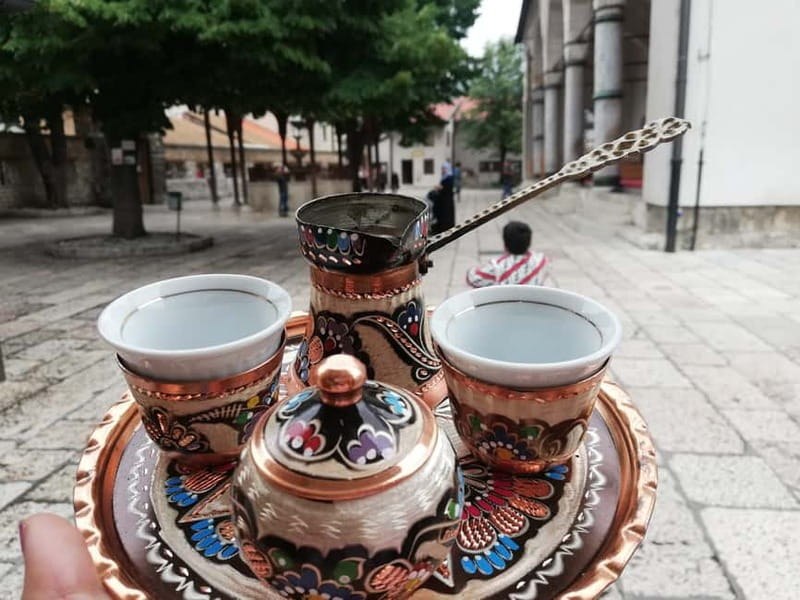
The tour enters Bravadžiluk and Kazandžiluk, two streets that bring you close to Sarajevo’s marketplace traditions and working crafts. Kazandžiluk is associated with copperware, and the tour uses the street to explain traditional metalwork and the role of crafts in local culture.
This section gives you something that a purely architectural tour might miss. You are not just looking at old buildings. You are seeing how commercial streets, food stalls, workshops, and handmade goods help keep the old center connected to daily life.
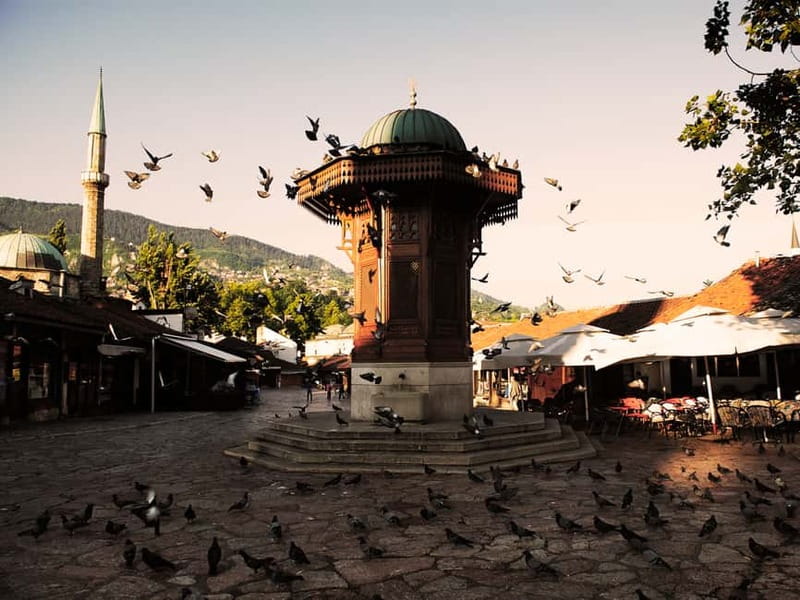
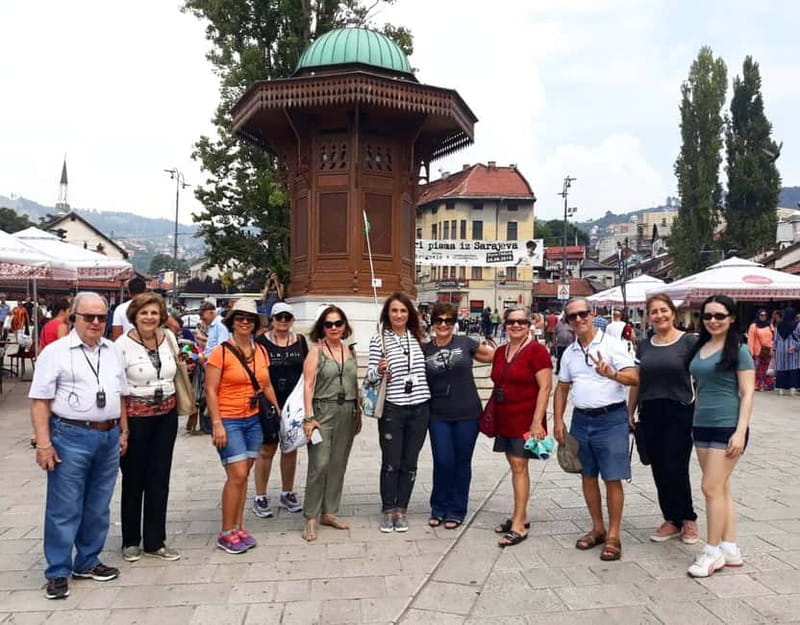
Next comes the Sebilj Fountain, Sarajevo’s famous wooden landmark and one of Baščaršija’s best-known meeting points. It is an obvious photo stop, but your guide adds value by explaining its place in local custom and the legends tied to it.
Baščaršija is likely to be one of the busiest parts of the walk. The area is full of shops, cafes, food, and people, so it can feel crowded at peak times. That is part of its appeal, but you should keep track of your group and listen carefully when the guide stops in a noisy street.
Morića Han and a taste of Bosnian sweets
Morića Han gives you a look at the old travel and trade network that supported Sarajevo’s Ottoman marketplace. A han was a lodging place for merchants and travelers, so this stop helps explain how goods, people, and ideas moved through the city.
The route also includes a baklava shop. Food is not included in the $21 price, but the stop introduces you to a familiar Bosnian sweet and the wider cafe and dessert culture of the Old Town. You can treat this as a chance to buy something, but there is no need to plan on a tasting being part of the tour.
The food element is modest, yet useful. Sarajevo makes more sense when you connect its history to what people still eat, sell, and serve. Your guide may also suggest places for Bosnian coffee or meals afterward. Those recommendations can be one of the practical benefits of taking the tour early in your stay.
Gazi Husrev-beg Mosque and the Meeting of Cultures
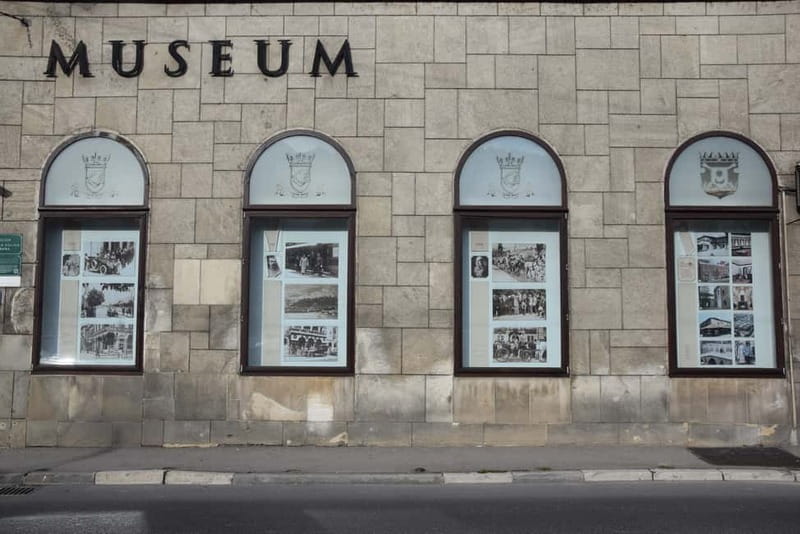
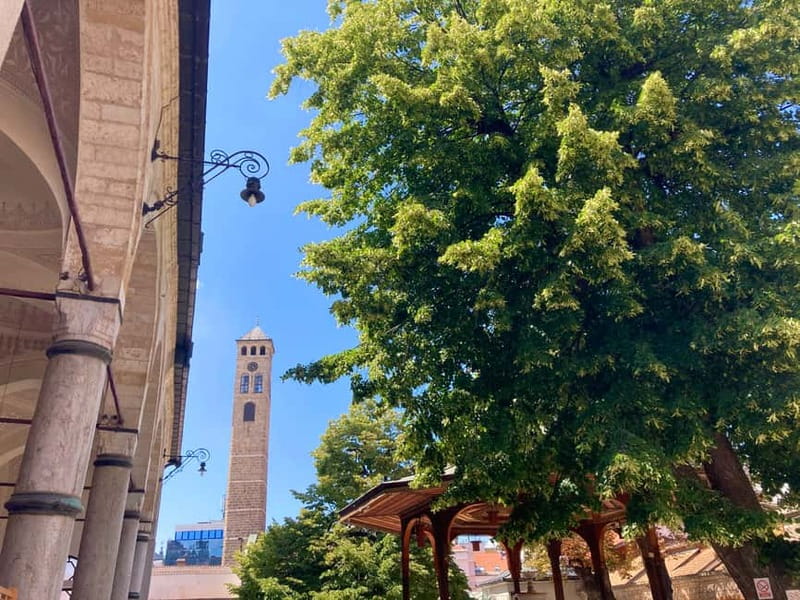
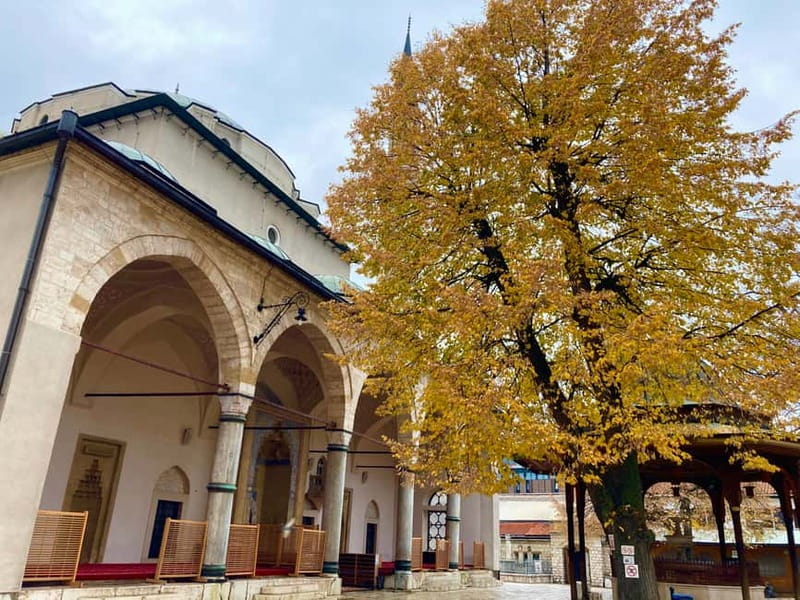
Gazi Husrev-beg Mosque is one of the major Ottoman-era sights in central Sarajevo. The guided stop helps you understand the mosque’s role in the city and gives you a closer look at the religious and civic importance of the surrounding district.
You should follow the guide’s instructions about clothing and access. The published details describe a guided photo stop and walk, not a guaranteed extended interior visit, so do not book this expecting a formal mosque tour.
The Sarajevo Meeting of Cultures marker is one of the clearest points on the route. It marks the place where the Ottoman-style Old Town gives way to the Austro-Hungarian city. In a single glance, you can see why Sarajevo is often described as a bridge between East and West.
This is also where the tour’s theme becomes most concrete. The contrast is not theoretical. The street plan, shopfronts, materials, and building styles change as you walk a short distance.
Jewish, Catholic, and Orthodox Sarajevo
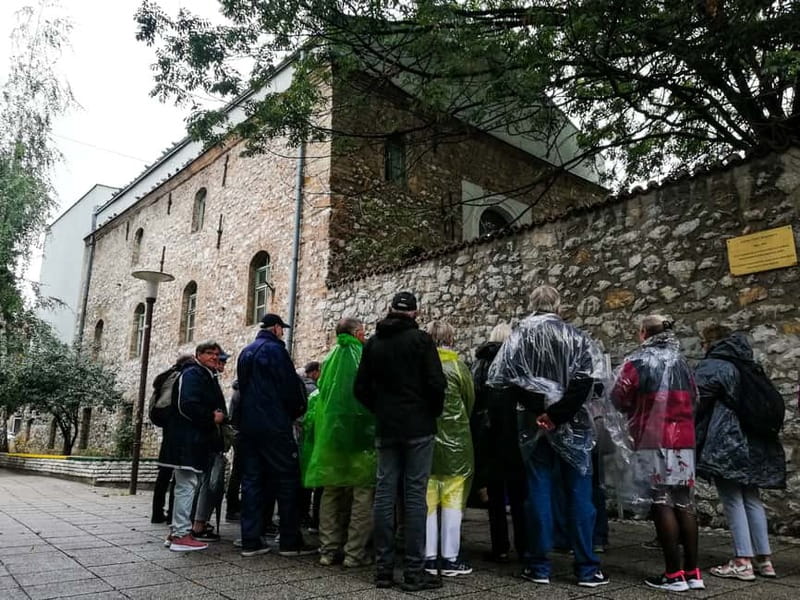
The Museum of the Jews of Bosnia and Herzegovina adds another part of Sarajevo’s cultural story. The tour includes a guided stop, but the information provided does not promise a full museum visit or admission. Think of it as a contextual stop that introduces the Jewish presence in the city.
The Sacred Heart Cathedral then brings Catholic Sarajevo into view. Its architecture and location help show how different religious communities have shaped the central city over time.
The Cathedral Church of the Nativity of the Theotokos represents the Serbian Orthodox tradition. Placing these sites in one walking route is valuable because it avoids reducing Sarajevo to a single cultural identity.
The guides also handle the city’s difficult past with care. Several guide experiences are praised for being factual and balanced when discussing the 1992 to 1995 war and the way it affected families. This is important. Sarajevo’s story includes trauma, but the city is not presented only as a memorial to suffering. The route also shows work, faith, food, humor, and ordinary city life.
City Market Hall and the Eternal Flame
The City Market Hall is a brief visit, listed at about five minutes. It gives you another look at Sarajevo’s food and commercial life, and it works as a practical bridge between the historic center and the city’s more formal public spaces.
The final stop is the Eternal Flame, a memorial connected with the city’s liberation in World War II. Ending here gives the tour a broad historical sweep, from Ottoman Sarajevo through Austro-Hungarian rule, world wars, Yugoslavia, and the modern city.
Some guides arrange the route so that the final stretch feels like a conclusion to the city’s timeline. Others may emphasize different details depending on their background and the questions in your group. That flexibility is useful if you enjoy conversation, though it means the exact feel can differ from one departure to another.
What the guides add to the experience
The guide can make or break a history walk, and this tour has a wide group of named guides praised for different strengths. Kenan is described as thoughtful, funny, and careful with the historical sequence. Elma is valued for excellent English, kindness, and clear answers. Bojan is especially warm when connecting Sarajevo’s wartime scars with its hopeful present.
Tarek, Masha, Hamza, Suad, Emina, Denis, Mohammed, and Lejla are also praised for combining facts with humor, local suggestions, and personal insight. The language choices include English, German, French, Italian, Spanish, Croatian, and Serbian.
The group may be private or small, depending on the option you choose. That matters because a small group gives you more room to ask about food, architecture, World War I, religion, or the 1990s war. One-person departures can even become private tours, though you should not assume that will happen.
Is $21 good value for three hours?
At $21 per person, I consider this a strong-value introduction to Sarajevo. You receive a licensed guide, a city map, and three hours covering a large number of central sights. Food, drinks, and any personal purchases are extra.
The value is highest if you are visiting for the first time or staying only briefly. You get orientation, historical context, and practical suggestions without paying for transport between sites. The tour also saves you from trying to piece together the city’s Ottoman, Austro-Hungarian, religious, and wartime stories on your own.
It is less suitable if you prefer long museum visits, free time at every stop, or a quiet photographic walk. Many locations are photo stops or short guided visits, so you will gain breadth rather than detailed time inside each attraction.
Free cancellation up to 24 hours ahead and the option to reserve without paying immediately make the booking relatively flexible. Starting points and meeting details can vary by the selected option, so check those details before you set out.
Who should book this Sarajevo walk?
I would choose this tour early in a Sarajevo visit if I wanted a clear introduction to the city. It suits history fans, first-time visitors, solo travelers, couples, and small groups who want both major sights and local explanation.
It is also a good match for visitors interested in the World War I connection but willing to look beyond 1914. The Latin Bridge is important, yet the tour gives equal attention to markets, religious buildings, crafts, architecture, and the city’s modern identity.
You should think twice if walking for three hours is difficult. The activity is marked wheelchair accessible but also says it is not suitable for people with mobility impairments, so contact the provider with precise questions about surfaces, pauses, and access before booking.
Should you book it?
Book it if you want Sarajevo to make sense quickly. The route covers the essential central sights, but its real value is the connections between them. You see where Ottoman Sarajevo ends, where Austro-Hungarian Sarajevo begins, and how several religious and cultural traditions share the same compact city center.
I would especially recommend it for a first visit, a short stay, or anyone who wants a local guide before exploring museums and restaurants alone. Skip it only if you already know central Sarajevo well or prefer to spend three hours inside a small number of buildings.
FAQ
How long does the Sarajevo walking tour last?
The tour lasts three hours. Starting times depend on availability and the option selected when booking.
How much does the tour cost?
The listed price is $21 per person. Food, drinks, and personal purchases are not included.
Which languages are available?
The live guide may speak English, German, French, Italian, Spanish, Croatian, or Serbian. Check the available language when selecting your booking option.
What sights are included?
The route includes the Latin Bridge, Emperor’s Mosque, Sarajevo City Hall, House of Spite, a viewpoint, Bravadžiluk, Kazandžiluk, Sebilj Fountain, Morića Han, Gazi Husrev-beg Mosque, the Sarajevo Meeting of Cultures, the Museum of the Jews of Bosnia and Herzegovina, Sacred Heart Cathedral, the Cathedral Church of the Nativity of the Theotokos, City Market Hall, and the Eternal Flame.
Is food included?
No. Food and drinks are not included, although the route includes a stop at a baklava shop and passes through areas known for Bosnian food and traditional market culture.
Can I cancel the booking?
Yes. You can cancel up to 24 hours in advance for a full refund. A reserve-now, pay-later option is also available.
New routes in the world
- Baltimore Walking Foodie Tour in Fells Point★ 5.0 · 182 reviews
- Baku Oil Heritage & Old Town Walking Tour★ 5.0 · 232 reviews
- Baku Walking Tour (Old City)★ 5.0 · 127 reviews
- The Madam’s Curse Walking Ghost Tour★ 4.5 · 103 reviews
- Austin Small Group Morning Walk★ 5.0 · 412 reviews
- Austin Haunted Pub Crawl Walking Tour★ 4.5 · 232 reviews
- Austin Downtown Private Walking Food Tour With Secret Food Tours★ 5.0 · 71 reviews
- Austin Murder Walk★ 5.0 · 310 reviews
Tours, compared.
Magical London: Harry Potter Guided Walking Tour
Read our review →
History and Hauntings of Salem Guided Walking Tour
Read our review →
New Orleans Premier Ghost, Voodoo and Vampire Walking Tour
Read our review →
Amsterdam Anne Frank: Small-Group Walking Tour & Local Guide
Read our review →
Edinburgh Castle: Guided Walking Tour with Entry Ticket
Read our review →